
Baylor Has No Search Portal
The Baylor County Sheriff, County and District Clerk, Justice Courts, and Seymour Municipal Court pages do not publish a public warrant or citation search. The Texas courts FAQ says the Office of Court Administration does not hold individual case records; contact the court or clerk. The image below shows that state-level route-to-court guidance.
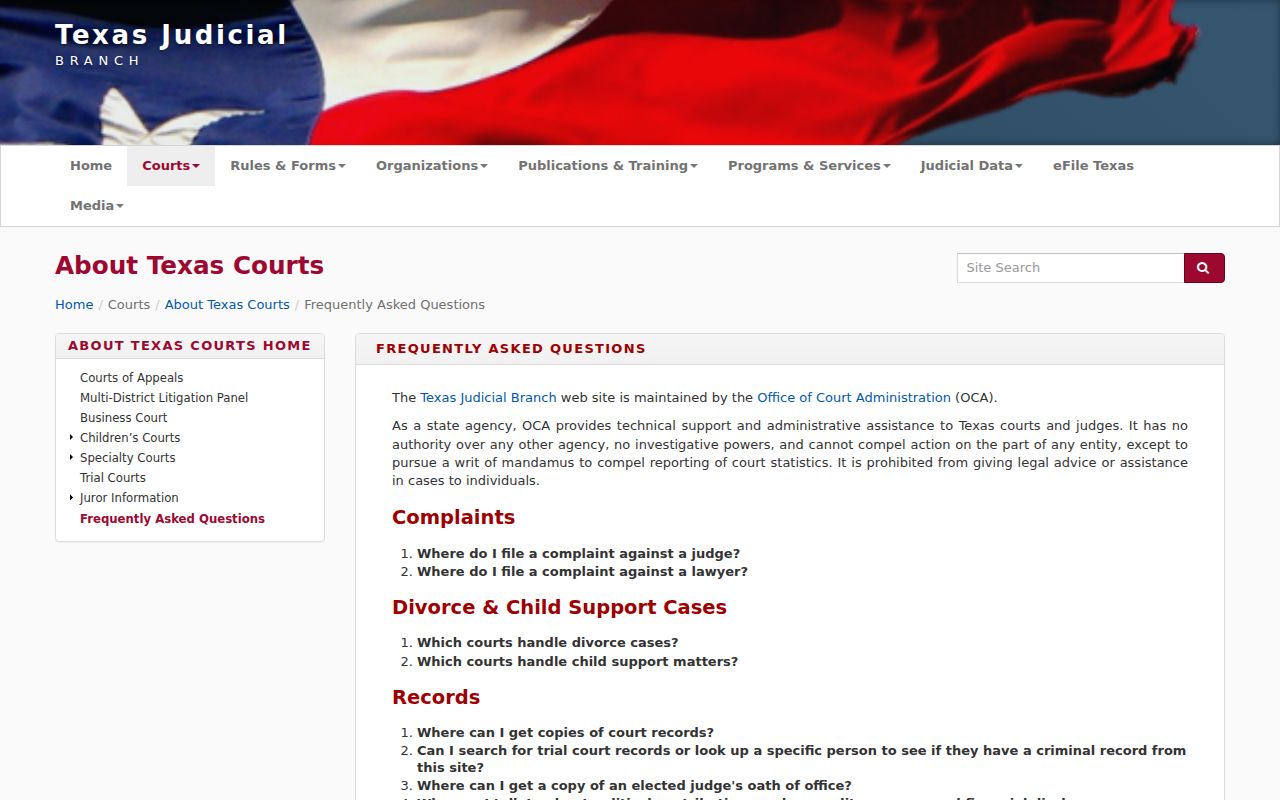
For Baylor, the useful search begins with the notice, the court name and a direct call. A negative result from a different agency cannot close the question.
How to Search for a Warrant in Baylor County
There is no all-courts database to enter a name into. Route by the paper: Seymour city cases go to Seymour Municipal Court, JP cases to Precinct 1 or 2, County Court criminal files to the County Clerk, and district criminal files to the District Clerk. Chris Jakubicek holds both county and district clerk titles, but a court-level label still matters.
Use identifying details only for your own matter or when helping a family member with permission. If a possible arrest warrant is involved, ask a Texas attorney how to check and appear safely.
- Read the citation, cause number or missed-court notice to find the court and precinct.
- Call Seymour Municipal Court at (940) 889-3148, JP1 at (940) 889-2662, JP2 at (940) 889-3300, or the combo clerk at (940) 889-3322, as the paper directs.
- Ask the clerk whether the case shows an arrest warrant, FTA process, capias, capias pro fine, or no warrant, and what status the court uses.
- Contact the Baylor County Sheriff at (940) 889-3333 for service questions. The sheriff page has no warrant list or dedicated online form.
- Use a written request for existing sheriff-held records if needed. Use the DPS/OmniBase page only for its narrow FTA/FTP renewal-hold check.
What to Have Ready
When calling a Baylor clerk, prepare the full name used on the notice, the citation or cause number, the approximate court date and the issuing city or JP precinct. The offices publish no local online search fields, no warrant-number pattern, and no name/DOB interface. A clerk can tell you which identifier the court needs for its own case file.
Do not send a Social Security number or unrelated private details through the sheriff's general contact form. It asks for basic contact information and a reason for inquiry; research found no public-information request checkbox or warrant search control there.
The combo clerk contact page gives the shared office route for district and county records.
Baylor County Warrant Search Fields
No Baylor court or sheriff search form exposes local filters. The only inspected public status interface is TexasFailureToAppear.com, maintained for DPS by OmniBase. It checks a limited reported hold, not every county warrant. These are its visible fields, not a complete Baylor case-search form.
| Field Label | Type | Required | Notes |
|---|---|---|---|
| Driver License Number | Text input | No marker shown | Use the person's own number for this limited status check. |
| Date of Birth | Date or text | No marker shown | Paired with the license number; do not publish it. |
| Search | Submit button | Action | Checks certain court-reported FTA/FTP renewal holds. |
| Local case search | Not available | None | Baylor court and sheriff pages expose no public search fields. |
| Federal docket | PACER account search | Registration | Case index only, not a warrant-status roster. |
DPS Shows a Narrow Status
TexasFailureToAppear.com asks for a driver's license number and date of birth. It reports certain court-submitted failure-to-appear or failure-to-pay conditions tied to license renewal. It does not search a person's complete criminal history, county roster, or every active warrant.
DPS says the court must resolve and report the matter; its update may take about three to five business days after that report. If a hold appears, contact the reporting court and ask what action is required. If no hold appears, continue with the issuing Baylor court because the interface does not certify a clean local record.
The image below shows the exact two-field state interface. It is for the account holder's own check.
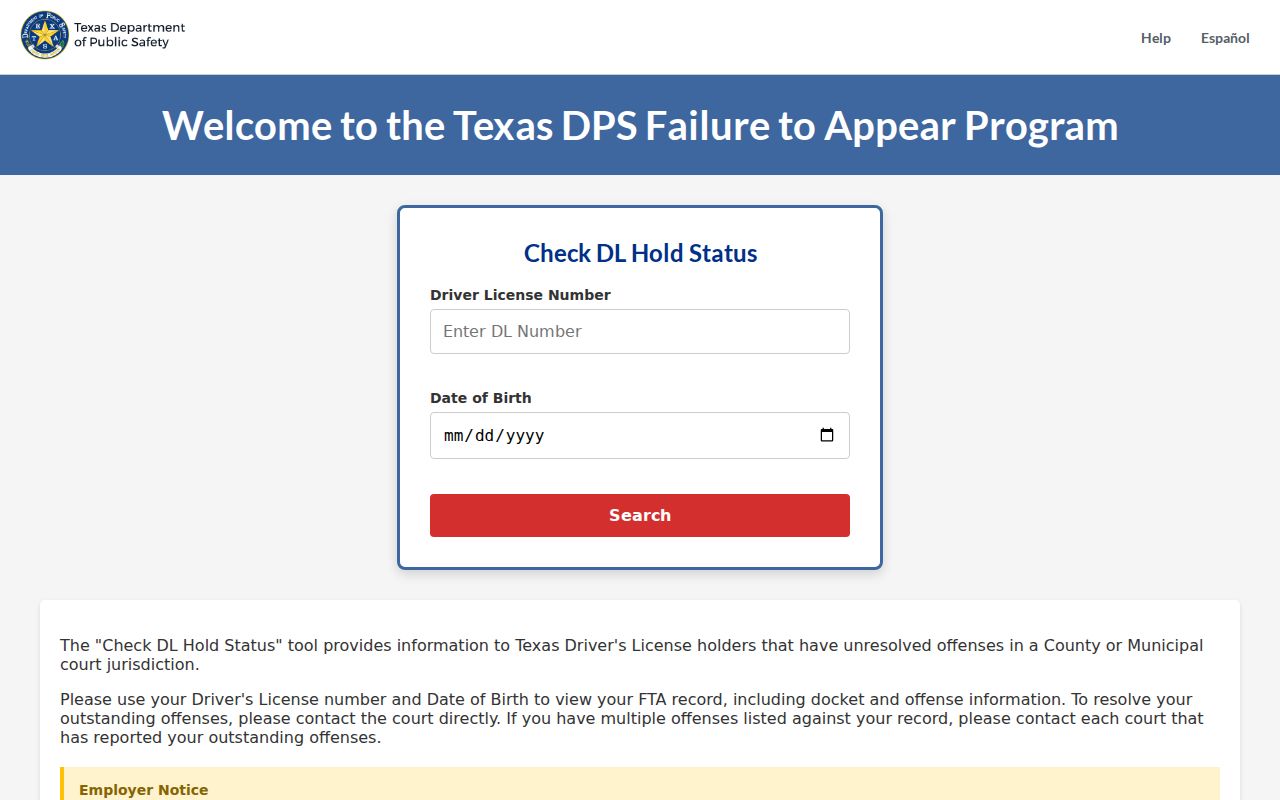
Do not confuse this renewal-hold service with a court docket or a warrant portal.
What a Baylor County Warrant Search Returns
Because Baylor has no public search interface, there is no standard local result screen to describe. A court or agency may confirm fields from its own file, but the sample below is a record schema only, not a real Baylor warrant or a promise that each item is public.
| Warrant number | Not publicly sampled; Baylor format was not located. |
|---|---|
| Charge / offense | Complaint or offense description tied to the case. |
| Issuing court | Names the judge or court that controls the process. |
| Bond or amount due | May be recorded separately; no countywide bond schedule was found. |
| Status | Ask the court to define issued, served, recalled or withdrawn. |
Baylor Written Requests
A written request can help document what an office was asked to search, but send it to the body that keeps the record. Under the Texas Public Information Act, a sheriff request should seek existing, narrowly described, non-exempt records. Court case files use court-record rules, so a PIA letter is not a substitute for the clerk.
The Texas Attorney General request guidance allows written requests through approved delivery methods and says to keep proof. Ask for the person's own status or a specific case record, not a bulk list or a new investigation. Baylor published no warrant-specific copy fee or turnaround time.
The image below summarizes the state's written-request route, not a Baylor submission form.
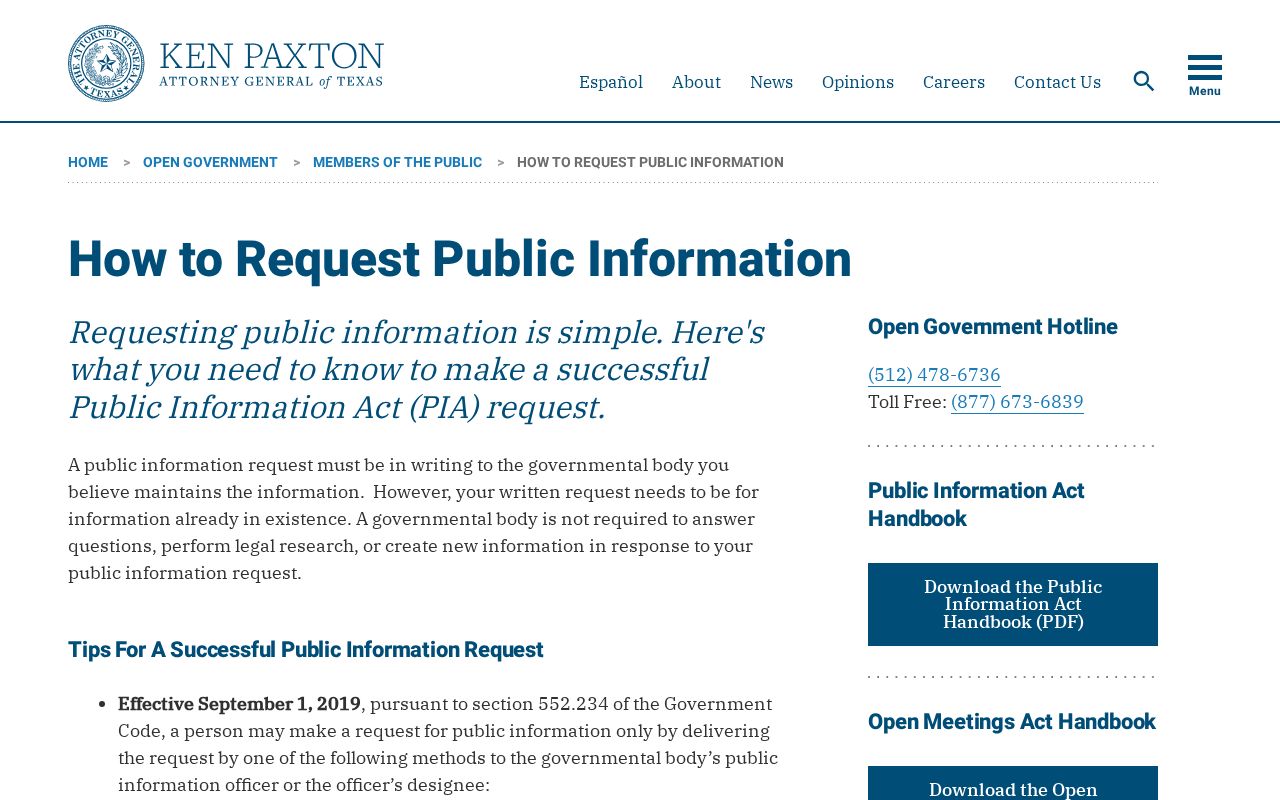
Ask the first office to identify the correct court if it does not hold the requested record.
Where Baylor County Warrants Are Checked
The issuing court holds the main case route. District criminal matters go to the 50th District Court and District Clerk. County Court criminal matters go to the County Clerk. JP1, JP2 and Seymour Municipal Court keep their own lower-court case records. The Baylor County Sheriff is the county law-enforcement contact for service or custody questions, not the general keeper of every court file.
Texas has no single Judicial Branch portal for all individual case records. The DPS/OmniBase interface is narrower still. For a federal case, Baylor is in the Northern District of Texas, Wichita Falls Division; PACER's national index locates public federal dockets but does not certify a live warrant status.
Baylor Courts Keep Separate Files
A Seymour ticket does not route to the same desk as a JP citation. The city court is at City Hall, while both JP offices are at 101 S Washington and use separate phone numbers. County and district criminal records share Chris Jakubicek's clerk office, but the clerk needs the court level to direct the request.
For municipal or justice-court process, Chapter 45A supplies the Texas framework. The court can say whether the document is an FTA arrest warrant, a capias, or a post-judgment capias pro fine. A generic sheriff inquiry cannot replace that court-side status check.
Access and Restricted Warrants
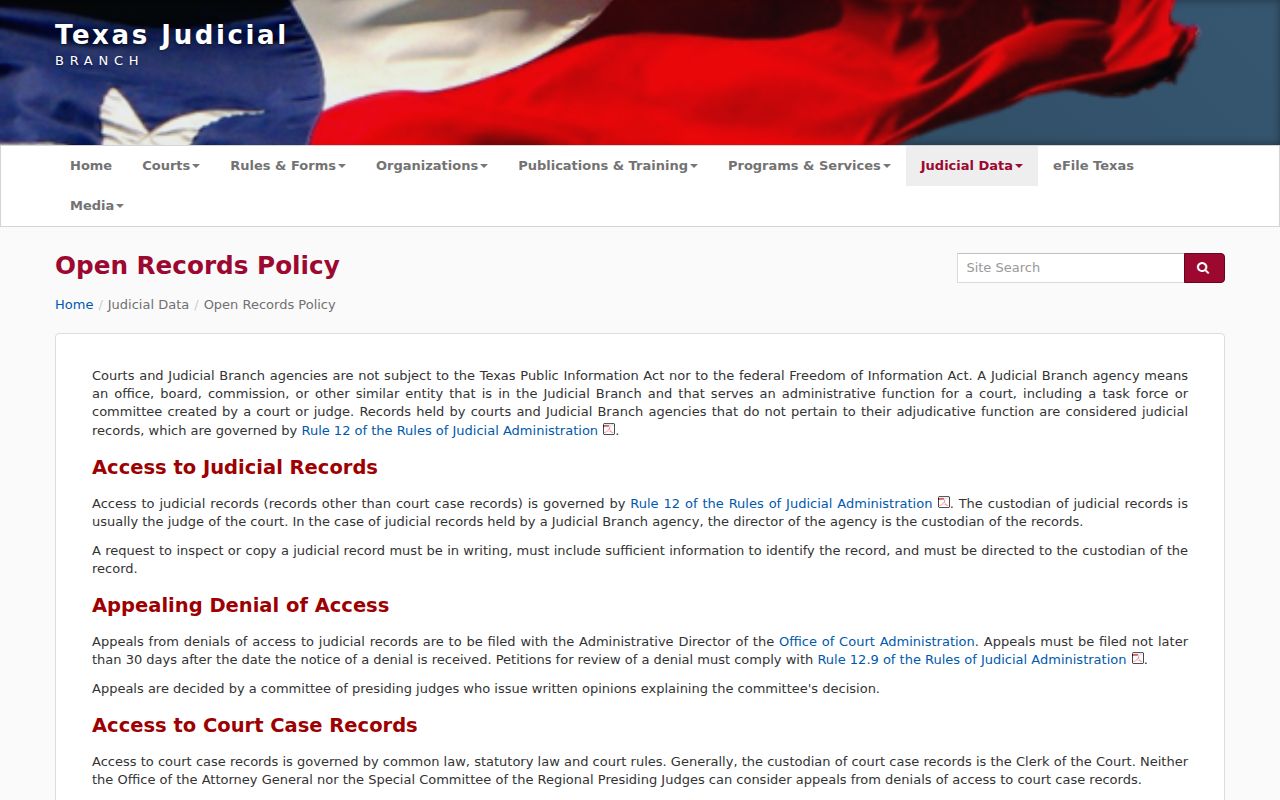
Public access depends on who keeps the record and what kind of record it is. The Texas courts open-records policy separates court case files from non-adjudicative judicial records. The sheriff's administrative or investigative files may also include information withheld under Chapter 552 exceptions. Ask for a specific record and accept redactions where a rule applies.
Key Rules:
A Texas court decision described in the OCA policy treats an arrest warrant and supporting affidavit as public under Article 15.26 in that context; it does not open every investigative attachment.
Juvenile, sealed and protected material may have separate limits. Ask the clerk what legal rule controls a particular record.
No result from a limited state interface or a different office is not proof that every Baylor court has no process. Confirm with the issuing court.
The Rule 12 image below explains why a court-record request follows a different path from a sheriff request.
For a matter that appears to involve an arrest warrant, a Texas lawyer can help identify the safe, lawful next step.